Ever wonder why goat yoga works so well?
It is not the goat.
It makes you feel present.
You feel your breath. You feel your bodyweight pressing into the chair or the ground. You feel the goat.
You’re not worried about the future. You’re not frustrated with the past. You’re working with what’s happening right now.
The Mind Wanders
Dan Sullivan makes the same point in Thinking About Your Thinking. Stop every twenty minutes and ask, “What am I thinking about right now?”
You will discover how often you are not thinking about what you are doing.
Or the person standing in front of you.
In a face-to-face event, that’s rude.
At an event you are paying for — the attendees, the venue, the food — it’s downright wasteful.
Every business outcome you want from a live event requires a focused, engaged audience:
Sales conversations that build rapport and produce revenue
Networking that produces productive business relationships
Training that helps your team execute better
An incentive that actually makes people feel appreciated and work harder
Club members who go home talking about the tournament.
When their attention is somewhere else, the event cannot do its best work.
What the Yoga was Supposed to Buy
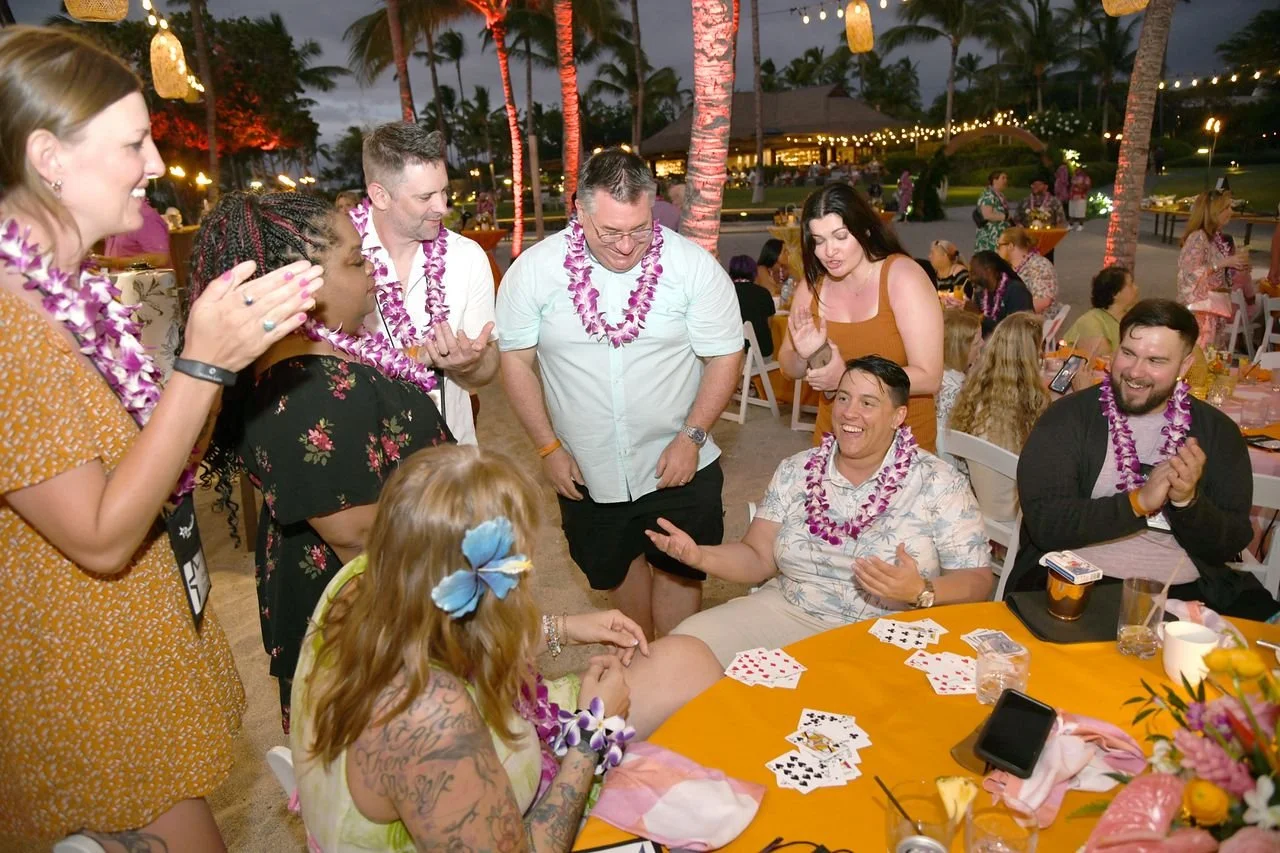
Last month I was working a reception. A guest observed how energy in the room had changed as I performed.
People were crowded in. They were talking about what had just happened. They were pulling the next person over saying, “You’ve got to see this.”
“You could feel it,” he said. “Everyone was so focused on what you were doing.”
That’s when it struck me: They were having the feeling the yoga was supposed to buy — without the silence, the breath-counting, or the goat.
That is what this magic is built to do. Capture, focus, and direct attention. Your mind cannot wander very far when something impossible just happened in your own hands, and the stranger next to you is reacting to it as well. You can’t help but focus on what’s happening now.
The audience is meditating. They just think they are being entertained.
Attention is the Leak in Your Event Strategy.
We spend a ton of money getting people to attend our events and creating an incredible experience for them. But in too many cases, they are not fully present—so they never get the full experience. If they aren’t fully engaged in your event, your event isn’t producing the return on investment it should be.
Every type of event suffers from a lack of attention and benefits from mentally engaged attendees:
Off-site Meeting or Sales Kickoff — Your team learns less if they're still thinking about what's going on back home or in the office. New ideas need a present mind. They share less of their real-world experience when they're not focused on the conversation. If they're mentally present during the event, they'll execute better when they get home.
Holiday Party— Company social events drown in shop talk. Give them something that's immediate and engaging, so they don't revert to the usual office conversation patterns. Spouses and plus-ones will not have to sit there like a fifth wheel while Hanrahan talks about the Greenberg account all night.
Conference — A short morning session wakes everyone up and focuses attention on the stage. A few short segments throughout the day can pull people back when their phones get more interesting than the speakers and PowerPoints.
Trade-Show Booth or Hospitality Suite — The flashing lights and giant booths of the trade show floor scatter attendees’ attention - your booth becomes another distraction in a sea of chaos. Capture attention at your booth and make the rest of the show floor disappear. Your prospects are unlikely to hear your message—or recognize the problem you solve—until you have their attention.
Member-Guest Golf Event — Players leave early because every Member/Guest follows the same dull protocol: golf, food, gift bag, leave. Engage your players with an experience so they see the details that make your club special. Your members will be proud.
The Masters Tournament Hospitality — There is so much more to a Masters trip than visiting Augusta National. Keep your guests mentally present through the week so they actually enjoy the dinner, the after-dinner entertainment, your hospitality house, and the rest of the trip. That is how you get the camaraderie and rapport that makes an annual event mean something.
Incentive Trip or President’s Club — A five-star business vacation with the boss. Self-conscious winners show up early, sit by department, and hide in their rooms. If they never engage, your investment does not reward last year or grow next year. Break the ice. Create equal business stature. A shared experience helps people feel like they belong, so the incentive can do its work.
The ability to focus attention becomes a multiplier.
The event problems above come directly from conversations with clients planning annual meetings, customer events, trade-show hospitality, golf events, and incentive programs.
By adding safe, inclusive, corporate-clean interactive entertainment to welcome receptions, cocktail parties, hospitality suites, and other unstructured moments, they capture attention, create conversation, and keep guests mentally engaged in the event. That gives the rest of the event a better chance to do the business work it was designed to do.
At an annual distributor meeting: The event moved from a series of one-way lectures to an open forum. Distributors and end users began interrupting presentations to share real-world experience with one another. The vice president of sales loved how the engagement and participation made the event uniquely valuable to the users, and the users loved the real-world, actionable advice they collected.
At trade shows: Clients have increased year-over-year qualified-lead counts by three times or more by capturing the attention of prospects who would otherwise ignore them—and turning that attention into qualified conversations.
At a Fortune 500 hospitality suite: The suite became “the talk of the show.” Guests talked about it the next day in hallways, at booths, and even in the airport—giving sales reps and executives multiple opportunities to have expansion, reactivation, and referral conversations with their best customers.
At a motor-manufacturer’s hospitality event: Attendees began calling friends at other companies’ suites—including GE’s—and saying, “You’ve got to come see what’s happening here.” The event did not just entertain the guests already in the room; it created demand to be in the room.
Think about the events you are hosting now.
What would change if your guests were actually in the room—not half on their phones or mentally somewhere else?
How much more could the event you already planned accomplish?
If you are tired of seeing faces buried in phones—and suspect your event may be leaving opportunity on the table—call me at (561) 596-3877.
We will talk about what you’ve done in the past, what worked, and what you think could be better. Based on what you tell me, I will share what other companies have done at events like yours to capture attention, create conversations, and generate better business results.